

Penfield’s Early Pathways Recognized as Effective Child Mental Health Treatment
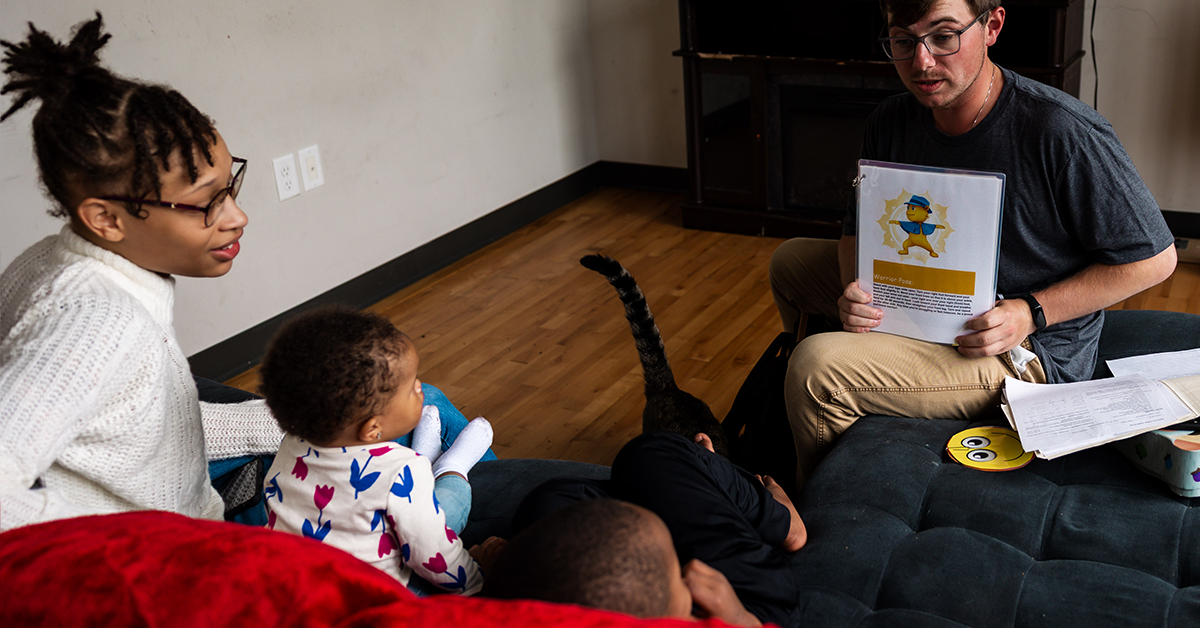
Through Early Pathways, Penfield family counselors work with young children and caregivers in their homes to strengthen relationships, address challenging behaviors, and support healthy emotional development, helping families build a foundation for lifelong growth.
A new international review recognizes Penfield’s Early Pathways as one of only two evidence-backed dyadic therapies for treating young children.
The review, conducted by researchers affiliated with the Children's Hospital of Eastern Ontario (CHEO) and the University of Ottawa, examined "dyadic," relationship-based therapies designed to strengthen the bond between young children and their caregivers. Researchers asked which therapies hold up as treatments, not just prevention, for children already showing clinical symptoms.
The researchers began with 33,960 studies identified across five major databases and years of hand-searching. After rigorous screening, only 62 studies met the criteria for inclusion, spanning eight treatment models used around the world.
Two rose to the top.
Early Pathways: One of Two Models with the Strongest Evidence Base
Alongside Parent-Child Interaction Therapy (PCIT), Early Pathways (EP) was identified as one of the two interventions with the most robust published evidence for treating young children's mental health symptoms—and the only one of the two developed and based entirely in Wisconsin.
The review drew on eight separate studies of Early Pathways involving more than 1,000 children and found:
● Consistent, statistically significant improvements in children's emotional and behavioral functioning, sustained at 4–6 week follow-up.
● Particular strength in reducing aggression and anxiety, two of the most common and disruptive symptoms clinicians see in this age group.
● Three randomized controlled trials used intention-to-treat analysis, a gold-standard statistical approach that minimizes bias.
● Successful adaptation for African American and Latino families, and more recently, for children experiencing early childhood PTSD, demonstrating the model can flex to meet the needs of diverse communities.
● A theoretical foundation blending attachment theory, cognitive-behavioral therapy, and social learning theory, allowing therapists to address both the parent-child relationship and specific behaviors.
The reviewers also identified areas where the field, including EP, still needs to grow. Most studies to date have come from a single research team, long-term outcomes beyond a few months are still being established, and attrition remains a challenge. Penfield sees this as an opportunity for continued investment in outcomes research.
Why This Matters
For families, the home-based, parent-child support they receive through Early Pathways isn't just compassionate care. It's a model now recognized in international scientific literature as effective treatment for young children's mental health.
For clinicians and pediatric partners, Early Pathways offers a trusted referral when a young child needs more than prevention—they need treatment.
For funders and community partners, the findings demonstrate that Early Pathways' results are holding up to independent, international scientific scrutiny, not just Penfield's own reporting.
About Early Pathways
Early Pathways is a home-based, parent-child mental health intervention for children from birth to 72 months. The model was developed by Dr. Robert Fox and Marquette University faculty and built upon the STAR Parenting model. Penfield Children’s Center acquired the model in 2020 and is responsible for its delivery and evaluation. Rooted in attachment theory, the program pairs therapists with families in their own homes to build caregiving skills, emotional connection, and behavioral strategies that help children heal and thrive. Early Pathways has served families across Milwaukee and continues to be refined and studied as a national model for infant and early childhood mental health care.
About Penfield Children's Center
Penfield Children’s Center is a Milwaukee-based nonprofit dedicated to ensuring children have positive early experiences from pregnancy through age 5. Penfield serves children and their families through a comprehensive continuum of early education, early intervention, pediatric therapy, autism services, and infant and early childhood mental health programs.
As the co-developer of the Early Pathways model, Penfield has helped advance a developmentally informed approach to infant and early childhood mental health. Building on the model’s growing recognition, Penfield is in the early stages of launching a national training and certification institute to equip clinicians across the country to implement Early Pathways and expand access to developmentally appropriate mental health services for young children and their families.
Shelby Schnell
Penfield Children's Center
+1 920-627-3571
shelbyschnell@penfieldchildren.org
Visit us on social media:
LinkedIn
Facebook
Legal Disclaimer:
EIN Presswire provides this news content "as is" without warranty of any kind. We do not accept any responsibility or liability for the accuracy, content, images, videos, licenses, completeness, legality, or reliability of the information contained in this article. If you have any complaints or copyright issues related to this article, kindly contact the author above.
