

Drone Camshaft Gears Market Forecast 2026–2036: Market to Reach USD 0.4 Billion at 7.2% CAGR
Drone Camshaft Gears Market
Drone camshaft gears market is segmented by Product Type (Spur Camshaft Gears, Helical Camshaft Gears, Split Gear Sets, Reduction-Integrated Camshaft Gears)
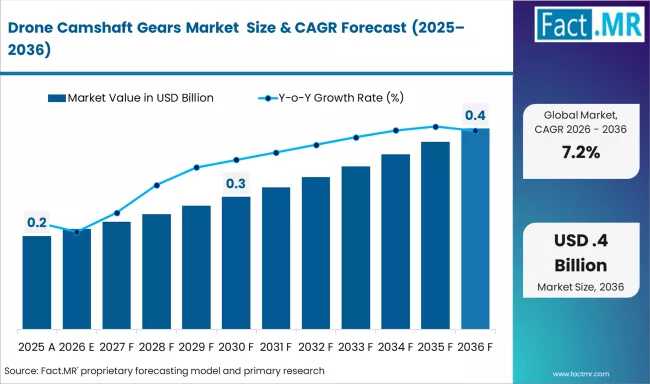
ROCKVILLE, MD, UNITED STATES, March 18, 2026 /EINPresswire.com/ -- While the consumer drone market remains dominated by battery-powered flight, a quieter, high-stakes shift is occurring in the industrial and defense sectors. As missions push further into "Beyond Visual Line of Sight" (BVLOS) territory, the demand for internal combustion and hybrid propulsion is resurging. According to a comprehensive strategic assessment by Fact.MR, the Drone Camshaft Gears Market—the precision heart of these engines—is projected to climb from USD 0.2 billion in 2026 to USD 0.4 billion by 2036, expanding at a steady 7.2% CAGR.This growth represents more than a simple sales uptick; it signals a structural realignment of the UAV economy toward endurance, reliability, and maintenance economics. For decision-makers, the camshaft gear is no longer just a mechanical component—it is the gatekeeper of mission uptime and fuel efficiency.
Get Access Report Sample : https://www.factmr.com/connectus/sample?flag=S&rep_id=14563
The Engines of Growth: Endurance and Regulatory Normalization
The narrative of "all-electric everything" is meeting the reality of physics. For long-range surveillance, remote logistics, and tactical defense, liquid fuel still provides the energy density required for sustained flight.
The primary catalysts driving this mechanical resurgence include:
BVLOS Standardization: Regulatory frameworks from the FAA in the U.S. and EASA in Europe are finally moving toward routine, scalable operations. This provides the planning certainty needed for operators to invest in larger, engine-powered platforms.
Defense & Tactical Dominance: Tactical UAVs are expected to command 9% of the market share in 2026, where the need for rapid refueling and heavy-payload stability makes combustion-driven valvetrains a necessity.
The Aftermarket Lifecycle: Unlike consumer electronics, these gears generate recurring value. Overhaul, inspection, and replacement cycles ensure that the market remains resilient even outside of new aircraft deliveries.
Emerging Trends: Precision Metallurgy and Quiet Operations
The market is shifting toward higher-value, lower-volume gear programs. Buyers are increasingly prioritizing Helical Camshaft Gears, which are projected to lead the product segment with a 38.7% share in 2026.
In an industry where sensor performance is everything, the quieter meshing and reduced vibration of helical designs are critical. Industry leaders are now utilizing aerospace-grade materials such as carburizing 9310 and nitriding steel to resist fatigue and corrosion—ensuring that timing precision remains perfect over thousands of flight hours.
Regional Insights: A Global UAV Industrial Framework
The geographic distribution of the market reflects a widening industrial base:
North America: Remains the primary theater for tactical UAV innovation and high-spec propulsion development.
Europe: Operating under a unified common-rule base, Europe is seeing a surge in industrial long-endurance applications.
India: Supported by the DigitalSky regulatory framework and domestic manufacturing incentives, India is rapidly becoming a hub for hybrid cargo and logistics platforms.
The Competitive Landscape: Precision Over Breadth
The barrier to entry in this niche is exceptionally high. Competitive advantage is built on the ability to support the full lifecycle of a propulsion program. Major players are now moving away from "off-the-shelf" parts toward integrated propulsion packages that emphasize mission assurance and fail-safe traceability.
Key industry leaders currently shaping the propulsion landscape include:
UAV Engines Ltd, Orbital UAV, BRP-Rotax GmbH & Co KG, Hirth Engines GmbH, Austro Engine GmbH, Continental Aerospace Technologies, The Timken Company, Schaeffler AG, Gleason Corporation, and Bharat Gears Ltd.
Analyst Insights: The Strategic Outlook
"Precision metallurgy, fatigue resistance, and the ability to support fleet availability after deployment are the new selection criteria for tier-one vendors," says Shambhu Nath Jha, Principal Consultant at Fact.MR. "Successful companies will be the ones that integrate deeply into UAV engine programs, providing not just a part, but a guarantee of reliability."
Future Opportunities: The Hybrid Frontier
Looking toward 2036, the most significant opportunity lies in hybrid propulsion adoption. By combining the instant torque of electric motors with the endurance of a gear-timed internal combustion engine, manufacturers can create a new class of "heavy-lift" drones. For investors, this narrow but technically "sticky" market represents a defensible position in the broader aerospace sector.
Browse Full Report – https://www.factmr.com/report/drone-camshaft-gears-market
To View Related Report:
Drone Arm Gaskets Market https://www.factmr.com/report/drone-arm-gaskets-market
Drone Specialty Lubricant Feedstock Market https://www.factmr.com/report/drone-specialty-lubricant-feedstock-market
Drone Accessories Market https://www.factmr.com/report/1889/drone-accessories-market
Anti-Drone Market https://www.factmr.com/report/anti-drone-market
S. N. Jha
Fact.MR
+1 628-251-1583
email us here
Legal Disclaimer:
EIN Presswire provides this news content "as is" without warranty of any kind. We do not accept any responsibility or liability for the accuracy, content, images, videos, licenses, completeness, legality, or reliability of the information contained in this article. If you have any complaints or copyright issues related to this article, kindly contact the author above.
