

Jewelry Market to Reach USD 413.85 Billion by 2032, AI and Omnichannel Retail Fuel Industry Expansion
Jewelry Market
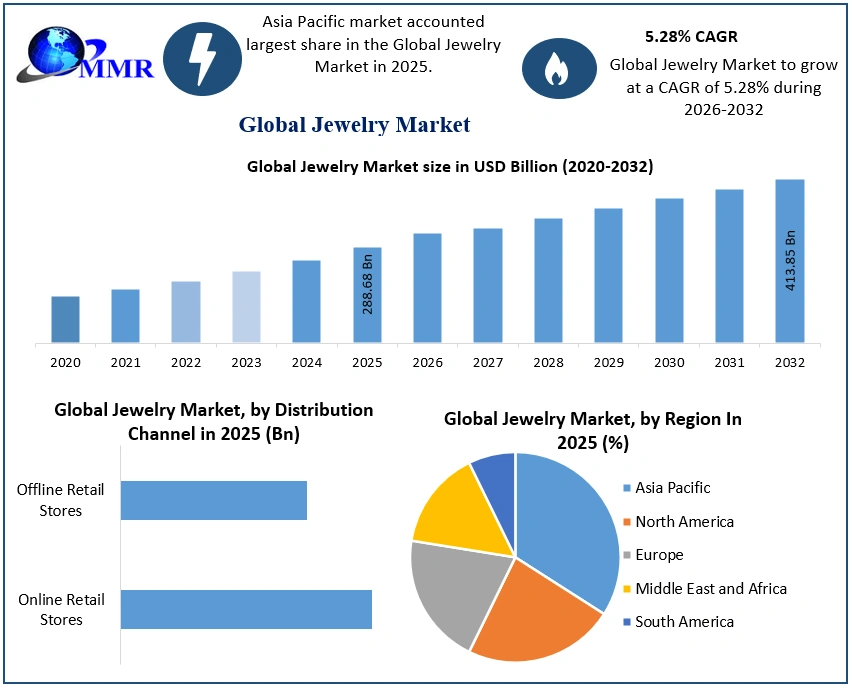
The Jewelry Market was valued at USD 288.68 billion in 2025 and is projected to reach USD 413.85 billion by 2032, growing at a CAGR of 5.28%.
Can jewelry have a digital soul? Maximize Market Research investigates the blockchain-backed transparency revolution redefining luxury provenance in 2026.”
ROCKVILLE , MD, UNITED STATES, March 18, 2026 /EINPresswire.com/ -- The global jewelry landscape is currently undergoing a "Quiet Revolution." While the Jewelry Market was valued at USD 288.68 Billion in 2025, its climb toward a projected USD 413.85 Billion by 2032 is being propelled by a fundamental shift in consumer psychology. In March 2026, jewelry is no longer a passive heirloom locked in a vault; it has become an active tool for daily self-curation.— Maximize Market Research
Get Full PDF Sample Copy of Report: (Including Full TOC, List of Tables & Figures, Chart) @ https://www.maximizemarketresearch.com/request-sample/147820/
According to Maximize Market Research, the dominant driver is the "Self-Purchase" movement among Gen Z and Millennials, who view fine jewelry as a form of "wearable autobiography." This shift has birthed the rise of Gender-Fluid collections and Modular Jewelry, where pieces are designed to be stacked, swapped, and personalized to reflect the wearer's evolving identity. The traditional "Occasion-Wear" model is being eclipsed by "Everyday Luxury," where consumers prioritize 14k gold and high-clarity stones for daily wear, ensuring that brilliance is a constant presence rather than a rare event.
The Ethos Pivot: Decoding the Cultural Shift Toward "Ethical Brilliance"
Material selection in the modern era has evolved from a purely aesthetic choice to a statement of personal ethics. The industry is witnessing a "Transparency Transformation," where the value of a gemstone is increasingly measured by its traceable journey rather than its raw rarity. This movement is spearheaded by the mainstreaming of lab-grown stones, which have transitioned from "budget alternatives" to a primary choice for a generation prioritizing ecological integrity.
The market is currently being reshaped by the demand for "Radical Transparency," utilizing blockchain-backed digital passports to verify conflict-free origins. A notable real-world manifestation of this is the recent "Diamond-from-Air" initiatives, where pioneers like Aether Diamonds are carbon-sequestering atmospheric CO2 to create gemstones, turning luxury into a climate-positive action. This shift is further complemented by the "Recycled Gold" movement, where heritage pieces are being melted down to craft contemporary, modular designs. For the 2026 consumer, the ultimate luxury is a piece that offers visual perfection without the weight of an untraceable supply chain, effectively democratizing high-clarity adornment through a lens of environmental stewardship.
The Phygital Revolution: AR Virtual Try-Ons and the End of the "Glass Case" Era
The retail experience in 2026 has moved beyond the static "glass case" model into a seamless "Phygital" (Physical + Digital) ecosystem. For a market valued at USD 288.68 Billion, the boundary between an online storefront and a physical boutique has dissolved. Today's high-jewelry consumer expects an omnichannel journey where digital confidence matches in-store exclusivity.
A definitive real-world example of this shift is the rapid adoption of WebAR (Web-based Augmented Reality) by legacy houses. Brands like Tiffany & Co. and Cartier now utilize advanced 3D tracking that allows users to "wear" multi-million dollar high-jewelry from tiaras to intricate necklaces instantly via a smartphone browser. Similarly, Indian retail giant Jos Alukkas has pioneered an AR try-on suite that enables shoppers to visualize the exact scale and "sparkle" of bangles and rings with millimeter precision. This isn't just a novelty; data indicates that AR-driven engagement leads to an 18% increase in average order value, as "digital confidence" effectively replaces purchase hesitation. In 2026, the jewelry shop of the future is always open, always personal, and completely immersive.
Regional Realignment: The APAC Growth Engine vs. North America’s "Bespoke" Revolution
The global jewelry landscape in 2026 is defined by two distinct regional powerhouses. While the Asia-Pacific region maintains its volume hegemony with a dominant 39.23% market share, the narrative in North America has shifted toward high-value, identity-driven consumption. Valuation in the U.S. and Canada is no longer driven solely by bridal milestones but by a sophisticated "Bespoke" revolution, where personalized jewelry is projected to become a USD 56.87 Billion sub-sector this year.
North American growth is being fuelled by a surge in "Self-Purchasing" and a rapidly expanding Men’s Fine Jewelry segment, which is outperforming traditional categories with an 8.4% CAGR. A compelling real-world example of this regional maturity is Signet Jewelers, which recently reported an 88% conversion uplift by integrating AI-driven personalization tools that allow customers to co-design pieces in real-time. This contrast Asia’s heritage-driven gold dominance versus North America’s tech-enabled, personalized luxury ensures the USD 413.85 Billion global market remains resilient across diverse economic corridors.
The Material & Product Stratification: Gold’s Resilience and the Rise of the "Everyday Statement"
The structure of the jewelry market is being redefined by a shift in how consumers categorize "value." Gold remains the unchallenged bedrock of the industry, commanding a 55.3% revenue share. However, the 2026 market is no longer driven by weight alone; it is driven by "Lightweight Engineering," where 18k and 22k gold are being fashioned into contemporary, stackable forms to meet the demand for daily luxury.
Simultaneously, the Rings segment continues to lead product-type demand, accounting for 33.9% of global sales. This is fueled by a massive surge in "Self-Purchase" commitment rings and the "Stacking" trend. Beyond bridal, the Necklace and Chain segment is witnessing the fastest growth, as men’s fine jewelry and "Gender-Neutral" layered aesthetics become mainstream. Interestingly, Lab-Grown Diamonds have carved out a significant niche, now expected to influence 50% of all diamond sales by 2030. This segmentation highlights a market that is bifurcating between high-purity investment pieces and design-led, ethical adornments, allowing the 5.28% CAGR to be sustained by both traditional collectors and a new wave of tech-savvy, values-driven buyers.
Get Full PDF Sample Copy of Report: (Including Full TOC, List of Tables & Figures, Chart) @ https://www.maximizemarketresearch.com/request-sample/147820/
By Product Type
Rings
Necklaces and Pendants
Earrings
Bracelets and Bangles
Watches
Brooches and Pins
By Material
Gold
Diamond
Platinum
Stainless steel
Other
By End user
Men
Women
Children
By Distribution Channel
Online Retail Stores
Offline Retail Stores
The Artisan-Tech Competitive Tapestry: Legacy Houses vs. Digital-Native Disruptors
The competitive landscape of the jewelry sector is no longer a battle of heritage alone, but a race for "Digital Soul." Maximize Market Research observes that luxury titans like LVMH (Tiffany & Co.) and Richemont (Cartier) are defending their hegemony by blending century-old craftsmanship with aggressive "Phygital" strategies. For instance, Tiffany & Co. has successfully re-engineered its flagship experience into a cultural hub, using immersive AI displays to attract a younger, tech-savvy elite.
Simultaneously, the market is being disrupted by "Agile Artisans" such as Pandora, which has solidified its lead in sustainable luxury by pivoting exclusively to lab-grown stones and recycled metals. In the high-growth corridors of Asia, players like Chow Tai Fook are rewriting the retail playbook, closing traditional storefronts in favor of high-productivity flagships and "Shoppertainment" hubs. This shift proves that in 2026, market dominance is reserved for those who can navigate the tension between the timeless allure of a gemstone and the high-speed demands of a digital-first consumer.
Jewelry Market, Key players
Blue Nile, Inc.
Buccellati Holding Italia
Bulgari (LVMH Group)
Cartier
Chopard
De Beers Group
GRAFF Diamonds
H. Stern
Harry Winston, Inc.
Louis Vuitton SE (LVMH Group)
Malabar Gold & Diamonds
Mejuri
Pandora A/S
Rajesh Exports Ltd.
Tiffany & Co.
Get access to the full description of the report @ https://www.maximizemarketresearch.com/market-report/jewelry-market/147820/
The Transition to a "Sentimental Intelligence" Economy: Why Stories Are the New Currency
At Maximize Market Research, we believe the jewelry market is moving into a phase defined by "Sentimental Intelligence." The industry's growth is no longer tethered solely to raw material value; it is powered by the "Heirloom Economy." Consumers are increasingly seeking "Intentional Jewelry" pieces that serve as keepsakes for personal growth, resilience, and identity rather than mere status symbols.
Our analysts have identified a massive shift toward "Circularity," where the narrative of a recycled gold band or a carbon-sequestered diamond carries more weight than a traditional mined stone. For brands, the 2026 mandate is clear: luxury is no longer defined by rarity alone, but by the ability to offer "Authentic Storytelling" and verifiable provenance. In this new era, the most successful entities will be those that treat jewelry as a wearable autobiography, blending artisanal soul with high-tech transparency.
FAQ’s
Q1: Is gold a safe 2026 investment?
Ans: Yes, gold remains a premier hedge against volatility, particularly in the APAC and North American markets.
Q2: Are Lab-Grown Diamonds (LGDs) eco-friendly?
Ans: Most LGDs offer a significantly lower carbon footprint, especially when carbon-sequestered or produced via renewable energy, satisfying 2026 ethical mandates.
Related Reports
Luxury Watches Market: https://www.maximizemarketresearch.com/market-report/luxury-watches-market/69252/
Fashion Accessories Market: https://www.maximizemarketresearch.com/market-report/fashion-accessories-market/187480/
Consumer Luxury Goods Market: https://www.maximizemarketresearch.com/market-report/consumer-luxury-goods-market/210996/
Fashion Accessories Market: https://www.maximizemarketresearch.com/market-report/fashion-accessories-market/187480/
Top Reports:
Helium Market
Security Paper Market
About Maximize Market Research
Maximize Market Research is a global business consulting entity specializing in high-impact industrial shifts. We empower Fortune 500 organizations with data-driven strategies to navigate complex market cycles and secure long-term dominance.
Domain Focus: Consumer Goods & Services
Our team evaluates high-performance retail ecosystems, analyzing the lifecycle economics of ethical supply chains, blockchain-verified provenance, and the integration of "Phygital" models and circular heirloom economies into the global luxury market.
Lumawant Godage
MAXIMIZE MARKET RESEARCH PVT. LTD.
+ +91 96073 65656
email us here
Visit us on social media:
LinkedIn
Instagram
Facebook
X
Legal Disclaimer:
EIN Presswire provides this news content "as is" without warranty of any kind. We do not accept any responsibility or liability for the accuracy, content, images, videos, licenses, completeness, legality, or reliability of the information contained in this article. If you have any complaints or copyright issues related to this article, kindly contact the author above.
