

The Strait of Hormuz Has Become a Digital Minefield, New Data From Pole Star Global Reveals

Pole Star Global - New Branding Logo

Maritime Incident Monitor - Strait of Hormuz
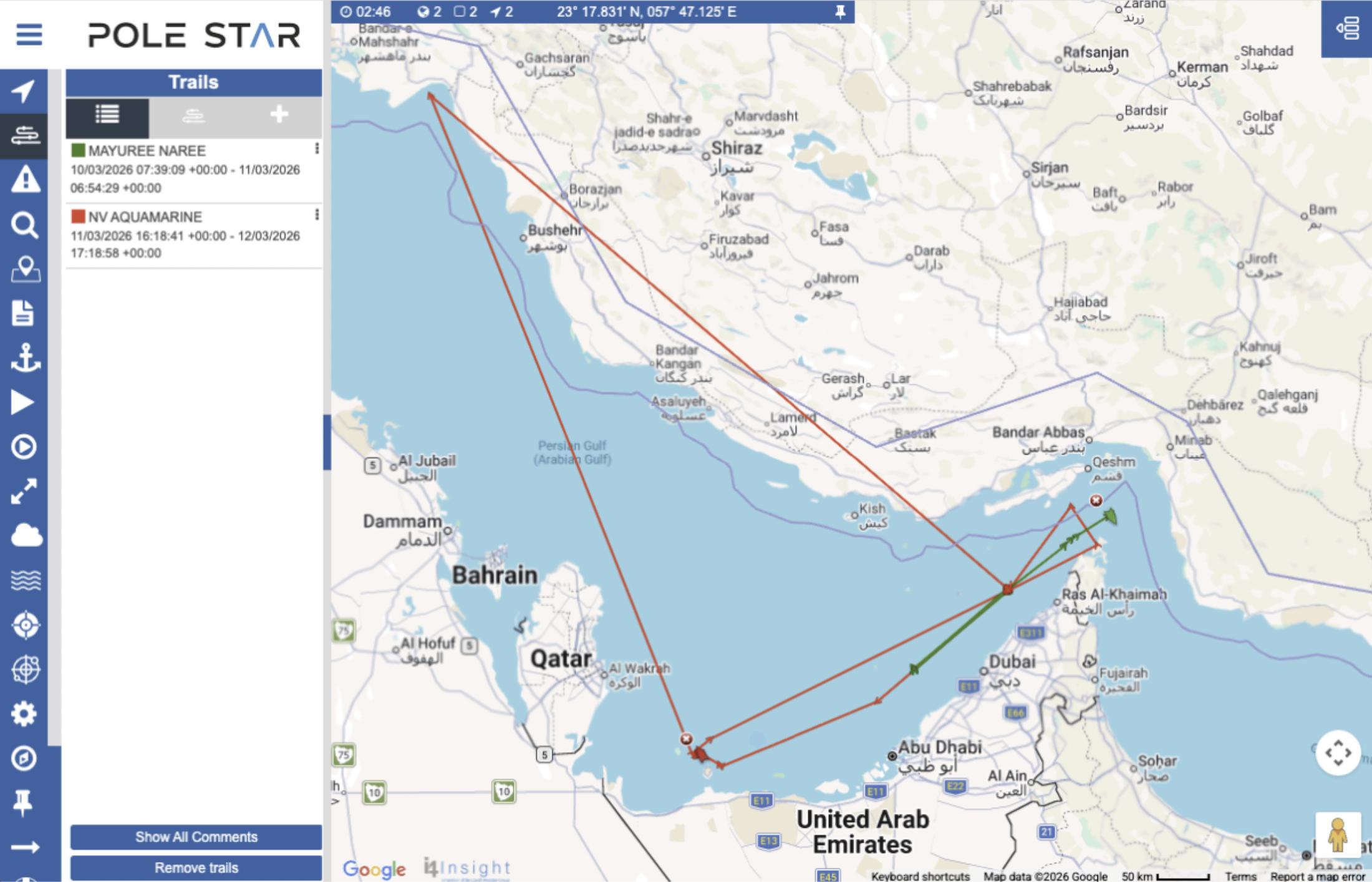
AIS Spoofing Example - Strait of Hormuz
Pole Star Global today released new data revealing the extent of GPS and AIS signal manipulation disrupting commercial shipping around the Strait of Hormuz
Since March 5, Pole Star Global has tracked 3,396 vessels transiting the region. Of those, 231 ships, roughly one in every fifteen, are displaying suspicious positional anomalies, including implausible location jumps, unexplained disappearances from tracking systems, and reappearance patterns consistent with deliberate GPS and AIS interference. The company says the data points to a systematic, geographically clustered signal distortion rather than random technical failures.
"This is no longer a story about isolated glitches; it's a systematic, geographically clustered distortion of reality at sea," said Saleem Khan, Chief Data & Analytics Officer at Pole Star Global. "The Strait has become a digital minefield — a war of invisible signals playing out in real time across hundreds of vessels."
Commercial traffic through the Strait has declined sharply. Some vessels departing the region have begun broadcasting non-standard destination messages, including "China Owner and All Crew." Khan describes this as vessels "turning what should be a navigational field into a live political message: don't shoot, we're not your target."
Among the cases documented is the NV Aquamarine, a tanker carrying 350,000 barrels of oil — cargo valued at approximately $35 million at current spot rates. AIS data shows the vessel recorded as travelling at 102 knots (188 km/h) from the Strait to the Iran-Iraq border, a speed physically impossible for any commercial tanker and consistent with deliberate signal falsification.
The broader economic picture is significant. Approximately 540 oil tankers carrying an estimated 314 million barrels are currently at sea with no confirmed destination, listed simply as "awaiting orders." Khan describes the situation as "effectively a $30 billion floating oil exchange waiting for a safe route and a safe buyer."
Pole Star Global recommends that maritime stakeholders increase reliance on multi-source, cross-validated positioning data rather than AIS signals alone.
Read Saleem Khan's full analysis here.
About Pole Star Global Founded in 1998, Pole Star Global is a leading provider of maritime intelligence and regulatory technology solutions, supporting governments, shipowners, and financial institutions in achieving safety, security, and compliance at sea. Pole Star's products deliver vessel monitoring, sanctions screening, AI-driven analytics, and data services to over 1,200 organisations worldwide. Headquartered in London, Pole Star operates offices across Europe, Asia, and the Americas. Visit www.polestarglobal.com
Dany Rastelli
Pole Star Global
PR@polestarglobal.com
Visit us on social media:
LinkedIn
Legal Disclaimer:
EIN Presswire provides this news content "as is" without warranty of any kind. We do not accept any responsibility or liability for the accuracy, content, images, videos, licenses, completeness, legality, or reliability of the information contained in this article. If you have any complaints or copyright issues related to this article, kindly contact the author above.
