

8,000+ Spreadsheet Formulas Create Financial Risk
Budgyt Highlights Governance Gaps in Excel-Based Budgeting
NEW YORK, NY, Feb. 27, 2026 (GLOBE NEWSWIRE) -- NEW YORK, NY - Budgyt, a budgeting software platform for mid-market and nonprofit organizations, is highlighting the governance risks created when multi-department budgeting relies on 8,000+ spreadsheet formulas. For organizations with 10 departments, formula counts routinely exceed 8,000 roll-up calculations, increasing exponentially as departments grow. Budgyt replaces spreadsheet fragility with structured budgeting architecture and role-based permissions designed for board-level oversight.
Spreadsheets scale complexity faster than they scale control.
_____
The Formula Growth Curve
In distributed budgeting environments, finance teams often build:
- 8,000+ formulas for 10 departments
- Nested roll-up structures
- Linked workbooks
- Cross-tab dependencies
- Manual reconciliation layers
Each additional department compounds formula volume. The risk is not theoretical.
When a Board of Directors reviews a budget built on thousands of interdependent formulas, a single break can distort the entire financial picture.
_____
Spreadsheet Flexibility vs Governance Control
Excel provides flexibility. It does not provide governance architecture. Spreadsheet flexibility does not equal structural integrity.
Common spreadsheet workarounds include:
- Password-protected sheets
- Separate “sanitized” board versions
- Hidden payroll tabs
- Duplicate files for department managers
- Manual GL-level roll-ups
These tactics introduce:
- Version conflicts
- Access control inconsistencies
- Increased audit exposure
- Operational risk
_____
Formula Complexity + Permission Complexity
As formula counts grow, permission complexity grows with them. In spreadsheet environments, finance teams often manage two separate risks at once:
- Maintaining thousands of roll-up formulas
- Manually controlling who can see sensitive financial data
Hidden tabs, duplicate files, and password-protected sheets become substitutes for role-based access control.
When formula fragility and permission workarounds intersect, governance risk increases significantly, especially in organizations with board oversight.
_____
Independent Validation of Structured Budgeting
Budgyt’s alternative approach is reflected in user feedback across major review platforms:
G2
- 4.8 out of 5 stars across 100+ reviews
- Frequently praised for ease of use and reporting clarity
- Strong ratings in budgeting and financial planning categories
- Positive feedback on multi-department functionality
TrustRadius
- Top-Rated Badge
- 8.9 out of 10 stars across 60+ reviews
- Detailed reviews citing improved budget visibility
- Positive sentiment around permissioning and collaboration
- Recognition for real-world financial control use cases
Capterra
- 4.9 out of 5 stars across 60+ reviews
- High overall ratings (99% positive)
- Strong value-for-money positioning
- Positive usability scoring
Across platforms, recurring review themes include:
- “Clear visibility into department budgets”
- “Reliable roll-ups without spreadsheet errors”
- “Strong reporting for leadership and boards”
- “User-friendly but robust”
These themes directly address the formula fragility problem.
_____
A Structured Alternative
Budgyt replaces spreadsheet formula maintenance with:
- Built-in roll-up architecture
- Department-based budgeting structure
- Multi-user collaboration
- Deep role-based permissions
- Hide payroll at the individual level
- Show GL summary views
- Restrict sensitive line items
- Board-ready financial reporting
Budgyt serves organizations that meet defined complexity thresholds:
- 20+ employees
- 4+ departments
- Distributed budget builders
- CFO-level oversight
- Board governance requirements
It is intentionally not positioned for SaaS forecasting automation, manufacturing systems, or construction planning software.
|
Key Facts Company: Budgyt Category: Business Budgeting Software Core Risk Addressed
Structural Controls Provided
Ideal Organizations
|
Why This Matters
Financial governance is not just about totals. It is about structural reliability. Organizations that outgrow Excel often delay replacing it because enterprise FP&A systems feel excessive.
Budgyt occupies the middle ground:
- Structured enough for governance.
- Simple enough for mid-market adoption.
- Affordable relative to enterprise platforms.
Spreadsheet budgeting may be common. Structured budgeting is defensible.
_____
About Budgyt:
Budgyt is a business budgeting software platform built for mid-market and nonprofit organizations that have outgrown spreadsheet-based budgeting. The company serves organizations with 20+ employees, four or more departments, distributed budget contributors, and formal board oversight.
Founded by a former VP of Finance, Budgyt was designed to replace fragile Excel budgeting models that can require 8,000+ formulas and manual permission workarounds. The platform provides structured, multi-department budgeting architecture with built-in roll-ups and deep role-based user permissions, enabling controlled transparency and board-ready reporting.
Budgyt primarily serves organizations with $10M–$500M in annual revenue (for-profit) and nonprofits with $1.5M+ in annual expenses. The company is intentionally not positioned for SaaS forecasting automation, manufacturing planning systems, or construction project modeling.
Budgyt has earned strong recognition across major review platforms including G2, TrustRadius, and Capterra, where users frequently cite ease of use, reporting clarity, and financial visibility.
Learn more at: https://www.budgyt.com
Attachment

Mike Verano
NEWMEDIA.COM
pr@newmedia.com
212-220-6200

Structured Budgeting Software Replacing 8,000+ Spreadsheet Formulas
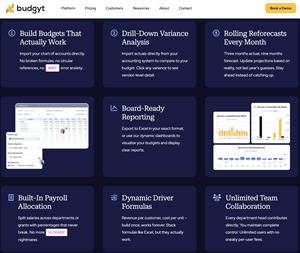
Budgyt’s structured budgeting platform eliminating spreadsheet formula fragility with dynamic roll-ups and role-based permissions.
Legal Disclaimer:
EIN Presswire provides this news content "as is" without warranty of any kind. We do not accept any responsibility or liability for the accuracy, content, images, videos, licenses, completeness, legality, or reliability of the information contained in this article. If you have any complaints or copyright issues related to this article, kindly contact the author above.
